
Founded in 1586, Erdene Zuu (100 Treasures) is the oldest surviving Buddhist monastery in Mongolia.
Over the years, the monastery went through periods of neglect, as well as periods of great revivals and prosperity. Erdene Zuu was perpetually in a state of fortification – building enclosure walls as protection against multiple invasions by Dzungar soldiers. Each time an attack was successfully repelled, buildings that were damaged had to be re-built.
At its height in 1872, the monastery compound had more than 60 temples and 300 gers (yurts) inside its walls, with close to 1,000 monks in residence.

Darkest Hour
The monastery was partially destroyed and closed during the period of Soviet domination of Mongolia in 1939. It was allowed to reopen in 1965 as a museum, BUT not a place of worship. Only 13 of the 62 temples remained.
Barely 2 hours after leaving Terkh White Lake, we were on snow covered roads. Fresh snow continued to fall over the next three hours.


The chain of stupas that form the exterior walls of the sprawling complex is the first thing that catches the eye. The perimeter wall measuring 1.76km was built to resemble a Tibetan Buddhist Rosary, featuring a total of 108 stupas (108 is a sacred number in Buddhism), spaced 15m apart.
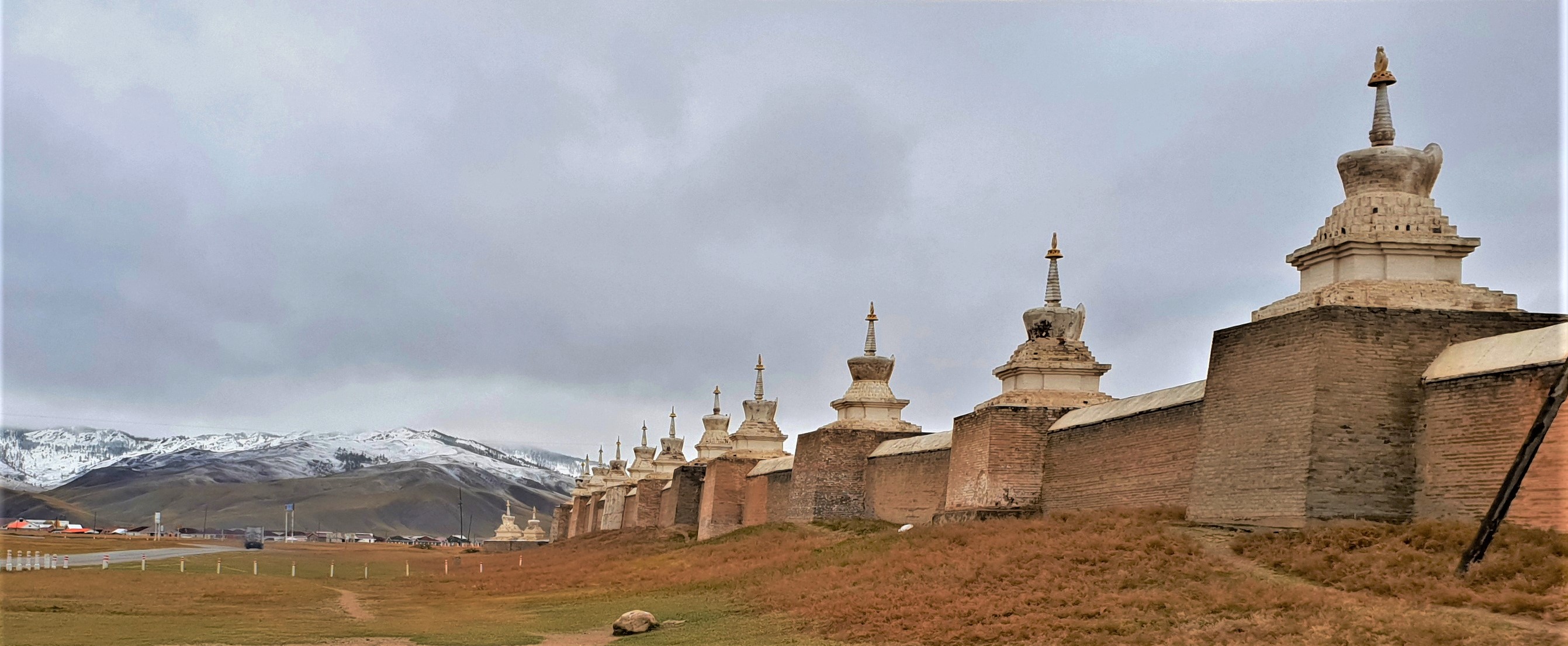
I immediately felt the chill as we left the warmth of the van and entered via the West Gate at 4.30pm. Though it had stopped snowing, the day was gloomy and laden with heavy grey clouds, as though to reinforce present-day Erdene Zuu as a pale shadow of its former glory.
Inside the West Gate, the vast compound appears bare and desolate with a cluster of buildings on the left, while straight ahead, a long distance away, lies more buildings.

The temple complex consists of three separate buildings that are excellent examples of Tibetan, Mongolian, and Chinese architecture.


Dalai Lama Süm was built in 1675 to commemorate the visit of Altai Khaan’s son, Altan to the Dalai Lama in Tibet.

Inside the courtyard on a raised platform, only three temples from the 16th century survived the 1930s Communist purge. Stones recovered from the ruins of Karakorum were used in the construction.

(l-r) Temples dedicated to the three stages of Buddha’s life – Baruun Zuu (adulthood), Zuu of Buddha (childhood), Zuun Zuu (adolescence)
The temples are filled with statues and intricate Tibetan Buddhist paintings on cloth called thangkas.


North of the temple complex is the Golden Prayer Stupa. Built in 1799, it is surrounded by 8 smaller stupas and houses 100,000 different Buddhas.

At the far end on the right is the Tibetan style Lavrin Süm temple, the only active temple where ceremonies are held every morning.

We concluded the day with a visit to the Museum of Karakorum, where an English speaking guide shared the history of 13th Century Mongol Empire. On exhibit are Stone Age / Bronze Age artifacts from ancient Karakorum. There is also an impressive scale model of ancient Karakorum in the 1250s.
Special Treat
Hogy & Lhagvaa wanted to make our final night in a Ger Camp truly memorable.
Hogy’s parents were our Ger Camp hosts. After 10 days on the road, we finally had WiFi! We were treated to a barbecue dinner followed by a traditional dance performance and Mongolian throat singing.
Traditional folk dance is mostly expressed by the movement of head, shoulder, chest and sprinkling hands.
First And Oldest Buddhist Monastery
Erdene Zuu Monastery was built in 1585-86 by Abtai Sain Khan, following his meeting with the 3rd Dalai Lama, and the declaration of Buddhism as Mongolia’s state religion.

Located in Övörkhangai Province, approximately 2km north-east from the center of Kharkhorin and just outside the ruins of Genghis Khan’s Mongolian capital of Karakorum, it is part of the Orkhon Valley Cultural Landscape World Heritage Site.

During Stalin’s time, much of the monastery was destroyed. Three small temples and the external wall with the stupas survived the initial onslaught.

In 1947 the temples were converted into museums for the next four decades. After the fall of communism in 1990, the monastery was returned to the lamas and Erdene Zuu once again became a place of worship.

Today Erdene Zuu remains an active Buddhist monastery as well as a museum that is open to tourists.
Visited 19 September 2018
 phoenixtrails.home.blog