
This is one destination where words are superfluous.

I’ll let the rainbow lakes, luxuriant forests, snow-capped mountains and gushing waterfalls do the talking instead.


Jiuzhaigou Scenic Areas
With a total length of over 50 km, 114 individual lakes, and waterfalls, Jiuzhaigou is composed of three valleys arranged in a ‘Y’ shape.
Intersecting at the magnificent Nuorilang Waterfall, they are
– Shuzheng Valley (main gully)
– Zechawa Valley (left gully)
– Rize Valley (right gully)

Rize Valley (18km)
From the entrance, we hopped onto the Green Bus and were deposited at the end of Rize Valley before 9am. For the first hour, we had the place to ourselves as we made our way back downhill on foot, passing through Primeval Forest, Swan Lake and Grass Lake.

The gullies are lined by wooden boardwalks and small pavilions to better appreciate the amazing scenery and ancient woodland.


Arrow Bamboo Lake
At an altitude of 2,618m, Arrow Bamboo Lake is named after the plant (favoured food of the giant panda) that grew in abundance along its banks.


Arrow Bamboo Falls
This 150m wide arc-shaped waterfall was formed by a collapsed embankment. The gushing white water contrasts beautifully with the blue lake, as it drops from a height of 7m.
Panda Lake
Surrounded by bamboo forests, this glistening lake with sandy beaches was once the drinking spot of giant pandas. With an average depth of 14m, the crystalline water features unique patterns of blue and green.
The lake empties into the multi-stream, multi-level Panda Waterfalls, dropping 78m in three steps. (We did not see this as it was dry on our visit).


It is home to the Songpan Naked Carp which gathers here in large numbers
‘Naked’ as in no scales due to the extreme concentration of calcium carbonate in the water.
Five Flower Lake
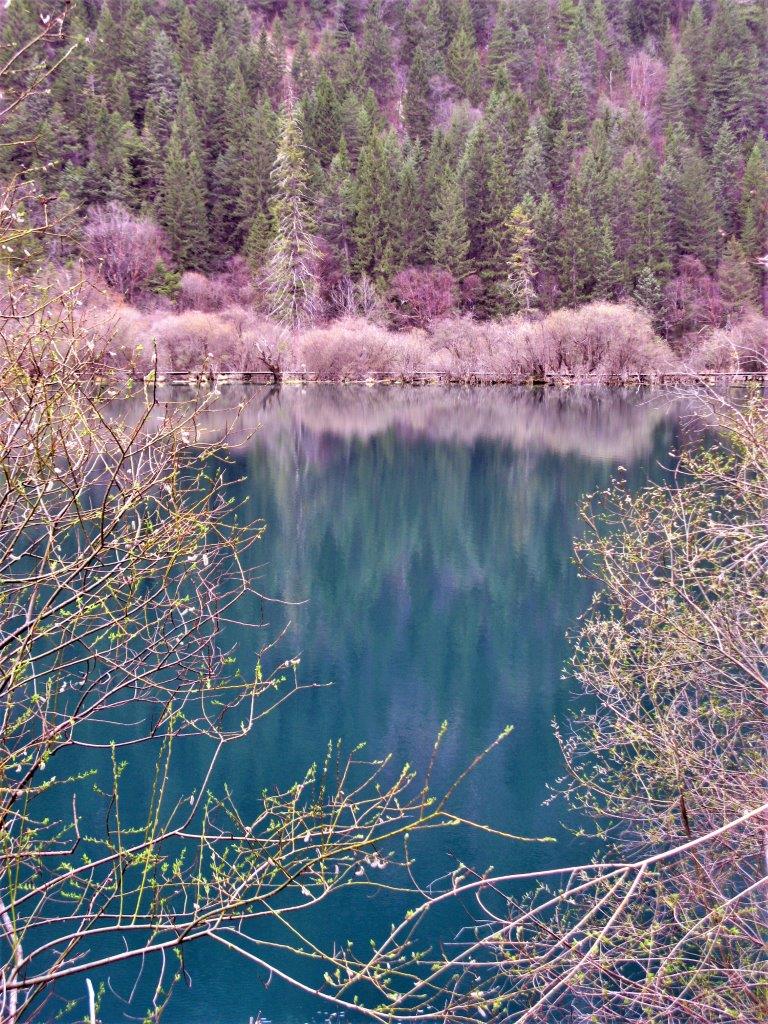
Regarded as one of the wonders of Jiuzhai Valley, the breathtaking colours of Five Flower Lake demonstrates Mother nature at its best. The reflections of Five Flower lake is an everchanging mixture of hues when viewed from different angles.


At an elevation of 2,472m, Five Flower Lake spreads over an area of 90,000sqm and is surrounded by mountains on three sides. Located at the end of Peacock River, it is fringed by yellow and green trees, and is just 5m deep.


Even in winter, this serene lake doesn’t freeze, offering clear views of its travertine bottom, aquatic plants and algae. When the sunlight hits the unevenly distributed submerged plants, a riot of colours appear, changing hues in tandem with the movement of the sun.

Adding to its mystique are the ancient fallen tree trunks that criss-cross the bottom of the shallow multi-colored lake.

It is also a favourite spot for bridal photography, as we soon discovered.


Pearl Shoal & Waterfall
A thin sheet of water flows down this gently sloping bed of travertine, creating a 160m wide curtain of water as it drops 21m into the Pearl Waterfall. Its name is derived from the sound created by the cascading water, that resembles a shoal of pearls spilling over the top of the fall.


Our gradual descent to 2,400 meters above sea level brought us to the junction of the Zechawa, Rize and Shuzheng valleys, which is also the tourist bus transfer center. We had lunch at one of the Tibetan restaurants before continuing our sightseeing hike.
Shuzheng Valley (13.8km)
With 40% of all of the lakes and ponds of Jiuzhai Valley located in this main valley, Shuzheng Valley extends from the mouth of the valley to the intersection of Nuorilang.
Nuorilang Waterfall
This majestic waterfall is the widest (320m) calcified waterfall in China, with a height of 24m. A viewing platform on the opposite side offers a full view of the Nuorilang Waterall. In spring, the falls are less impressive, unlike later in the season, when the melting snow from the mountains makes its way into the valley.
In winter, the view is even more dramatic. The frozen waterfall is like an enormous silver white ice curtain.

NB. Nuorilang Waterfall was severely damaged (reduced to a small trickle of water) in the 2017 Jiuzhaigou earthquake. Following repair works, the water flow has been restored as at August 2019.
Shuzheng Waterfall & Lakes
Measuring 62m wide with a mere 15m drop, Shuzheng Waterfall is the smallest and most ferocious of Jiuzhai Valley’s four waterfalls.


The convergence of multiple stepped branch pools from the adjacent Tiger Lake creates an impressive force and a deafening roar.
Shuzheng Lakes consists of 19 lakes, ponds and small streams of varied sizes, descending in terraces. Spread out over 5 km with a drop of 100m, some of the more popular lakes are Sparkling Lake, Tiger Lake and Reed Lake.

Reed Lake lies at the northern end of the cluster of lakes that begins just below Nuorilang Waterfall. Waterfowls are attracted to the densely packed reeds.
The Shuzheng River runs through the Shuzheng Lakes, as can be seen by the darker, jade-green water in the center.


Tibetan Villages
Our final stop was to Heye Village, the largest Tibetan village in Jiuzhai Valley National Park. We spent a delightful half hour immersing in Tibetan culture and folk customs.

The distinctive traditional Tibet-style buildings are extremely colourful, both the exterior and interior.


Visited 9 April 2013
Damaged by the 2017 earthquake, Jiuzhaigou was closed for two years for repair and restoration works. Its re-opening on 27 September 2019 was short lived, closing again in January 2020 due to the Covid-19 pandemic. When the park re-opened in March, only locals with Chinese ID are allowed entry. International tourists have to wait for further easing of travel restrictions before visiting.
So, is Jiuzhaigou still worth visiting post-earthquake? Here’s what Sichuan Travel Guide has to say.
Jiuzhaigou National Park
Jiuzhaigou translates to “valley of nine villages,” after the nine Tibetan villages scattered throughout the park that is rich in the folk customs of the Tibetan and Qiang peoples.

Located in Jiuzhaigou County 450 kilometers (280 miles) to the north of Chengdu, Jiuzhaigou valley is part of the Min Shan mountain range on the edge of the Tibetan Plateau, Northern Sichuan in South Western China. Stretching over 72,000 hectares (180,000 acres), it is best known for its  multi-level waterfalls, fabled blue-green lakes, narrow conic karst land forms and snow-capped peaks. Its elevation ranges from 2,000 to 4,500m (6,600 to 14,800ft).

Known as the place with the most beautiful natural scenery in China, the national park is home to over 220 bird species as well as a number of endangered plant and animal species including the giant panda, Sichuan golden monkey and the Sichuan takin. The flora and fauna includes incredibly beautiful orchids and rhododendrons.

Jiuzhaigou was designated a UNESCO World Heritage Site in 1992 and a World Biosphere Reserve in 1997.
 phoenixtrails.home.blog
What a beautiful place!
LikeLike
Yes it is, Janstu. I would visit again, in a heartbeat.
LikeLike