
November 2002
On my first ever trip to China, I finally had a proper bed to sleep on after 3 days of overnight travel (by air / train), waking up refreshed on the 4th day. From my base in Beijing, I ventured out daily, visiting popular spots over the next four days.
1. Former Residence of Soong Ching Ling
We took a cab to The Former Residence of Soong Ching Ling (wife of Sun Yat-sen and later Vice-President and Honorary President of the People’s Republic of China) in the Shichahai area of Beijing.
Located on the northern bank of Houhai Lake, the former residence occupies an area of more than 20,000sqm. The sprawling mansion is surrounded by a lake fringed by willows on its banks. We strolled around the picturesque grounds of artificial hills, admiring the graceful courtyard with meandering paths and corridors.

Famous for supporting the Communist Party of China after her husband’s death, Madame Sun devoted the rest of her life to women’s and children’s welfare. She lived here from 1963 onwards till her passing in 1981, at the age of 88.
Now converted to a museum, visitors can view her original living environment and learn more about her life story through photos and mementos on display.
Hutongs
By continuing our exploration on foot, we managed to experience the local culture and see the old lifestyle of ordinary people, as we made our way back to our hotel.
Our wanderings brought us to the hutongs around the Drum and Bell Towers. Hutongs are Beijing’s ancient networks of small streets and alleys with interconnected houses in old-styled buildings.

The pace of life is more relaxed in these charming narrow alleys, with locals gathering to sit around and chat.


Even then, we could already see signs of modernisation.
The number of Hutongs have been steadily dropping from 3,250 in 1949 to 1,500 by 2003. The majority of hutongs were being transformed into tourist attractions associated with street food, shopping, and bars.
Drum and Bell Towers

The Drum and Bell Towers are located north of the Forbidden City along the north-south axis that runs through Tiananmen Square and the Forbidden City.
Both towers can be climbed for panoramic views of Beijing, as well as views of the opposite tower.
Beihai & Jingshan Park
Next, we cut through Beihai Park, entering via North Gate 1. I was surprised when we had to pay an entrance fee before being allowed in. Located in the center of Beijing, this thousand-year old garden is one of the oldest, largest (175 acres) and best-preserved ancient imperial gardens in China.

By the time we connected to Jingshan Park, it had started to get dark. We quickened our pace and made it to Jingshan Front Street for a panoramic view of Forbidden City.

Jingshan Park boasts 57 acres of charming natural scenery and paved paths. This beautiful royal landscaped garden has a hill with five summits. Built in 1751, a pavilion sits on each of the five summits. The Wanchun Pavilion (Ten Thousand Spring Pavilion) offers panoramic views of Forbidden City in the south, Bell and Drum Towers in the north, as well as Beihai Park and Miaoying Temple in the west.
For my solo sightseeing, I started each day by asking the Hotel Front Desk to write down the targeted attraction spot in Chinese for me, including which bus / Subway line to get to there. This way, I can flash the destination to friendly locals and ask for directions along the way. I also made sure to carry the Hotel's address, to help me find my way back, after.
2. Forbidden City (Palace Museum)
Once the imperial palace for 24 Emperors of Ming and Qing Dynasties, the Forbidden City lies in the city center of Beijing. It gets its name from that time (over 5 centuries) when common people were forbidden to even approach the palace.
After the Last Emperor of China left the palace, it was converted into a museum and opened to the public in 1925. It was listed as a World Heritage Site in 1987 and is the largest, best-preserved ancient timber-built palace complex in the world. There are over 8000 wooden structures decorated with yellow glazed tile roof and bluish white marble base, in this ancient imperial complex.
Today, the world’s most-visited museum is no longer ‘forbidden’, allowing ordinary people to appreciate the precious cultural heritage of China.

Hall of Supreme Harmony
Buildings are aligned in harmony and symmetry along the central axis with huge squares and majestic ceremonial palace in the outer court, while quiet yards and delicate living chambers are found in the Inner court.
This architectural masterpiece is not just enormous, but is also a treasury housing a unique collection of 1.8 million pieces of art, including ancient calligraphy and painting, imperial artifacts, ancient books and archives.
- Most outstanding feature: It’s the largest imperial palace in the world
- Things to see : imperial living and governing quarters, valuable artworks, and traditional gardens
- The Forbidden City took 14 years to build (from 1406 to 1420)
- It was built by over 1,000,000 workers, including more than 100,000 craftsmen
- It was the imperial palace of China for 492 years (1420–1912)
- It was the home of 24 emperors — Ming dynasty (14) and Qing dynasty (10)
- It covers 72 hectares (as large as 101 football fields), of which 15 hectares (38 acres) are floor area
- It has 980 buildings in over 70 palace compounds, with over 8,703 rooms
- It is 961 meters long from south to north and 753 meters wide
- It is surrounded by a 10-meter-high wall, stretching 3.4 km (2 miles)
- It has a 52-meter wide moat around it
- It hosts 14 million visitors per year, a maximum of 80,000 visitors per day (pre-Covid)
Layout & Construction
Built according to ancient imperial capital’s construction principle, the Forbidden city is divided into two parts :
– Outer Court for national affairs, in the south
– Inner Court as living quarters, in the north
To emphasize the supremacy of the emperor, ceremonial halls for emperors to handle state affairs (outer court), imperial living quarters (inner court) and imperial garden are aligned from south to north along the central axis of Forbidden City (the same axis of Beijing City). Other buildings, like living palaces for emperor’s father and the former emperor’s concubines and palace for Buddha worship are located on the both sides of the axis.

Like thousands before me, I entered via the Meridian Gate located at the southern end of the complex. Once past the gate, I recalled my sister saying to me that “everything is big in China, REALLY BIG”. Looking at the immense courtyard before me, I finally understood what she meant.
Slowly soaking in the unfolding view of the inner Golden Water River snaking through the courtyard, to the five beautiful stone bridges stretching across it, and finally the Hall of Supreme Harmony, I was reminded of the iconic scene from the movie ‘The Last Emperor’.


Outer Court
- Hall of Supreme Harmony, the most important and largest structure in the Forbidden City. The emperors’ Dragon Throne (Longyi) is in this hall. During the Qing Dynasty, it was mainly used for ceremonial purposes, such as coronations, investitures, birthdays and imperial weddings.
- Hall of Middle Harmony, the resting place of the emperor and to rehearse their speeches before presiding over grand events held in the Hall of Supreme Harmony.
- Hall of Preserving Harmony, used for state banquet in the New Year’s Eve and Lantern Festival, and later for imperial examinations.

Between the stairways of the Hall of Preserved Harmony, a huge marble relief of nine dragons playing with pearls, sea water and clouds sits in the center. Carved from a 200-ton chunk of white marble, it is the largest stone sculpture in the Forbidden City at 16.6m.
Sculpted originally in the Ming dynasty, it was re-sculpted in the Qing dynasty.
Inner Court
- Palace of Heavenly Purity was the living quarters and workplace of 14 Ming & Qing Emperors (1420 – 1722). Later it became the emperor’s audience hall.
- Palace of Union and Peace is where the imperial seals were stored.
- Palace of Earthly Tranquility was the residence of the Ming Empress. In the Qing Dynasty, it became a shamanist worship place. It was also used on the emperor’s wedding night.


Left picture : Huge gilded vats outside the Palace of Heavenly Purity. Each vat contains 200 gallons of water to be used for putting out fires. There are 308 vats all over the Forbidden City.
Roof Decorations
I could not help but notice a row of mystical animal statuettes along the ridge line of the halls. The number of animals vary, base on the importance of the buildings and function.
The Hall of Supreme Harmony, the most important structure in the Forbidden City, has 10 roof ridge statuettes while there are seven on the Palace of Earthly Tranquility, the residence of the Empress.

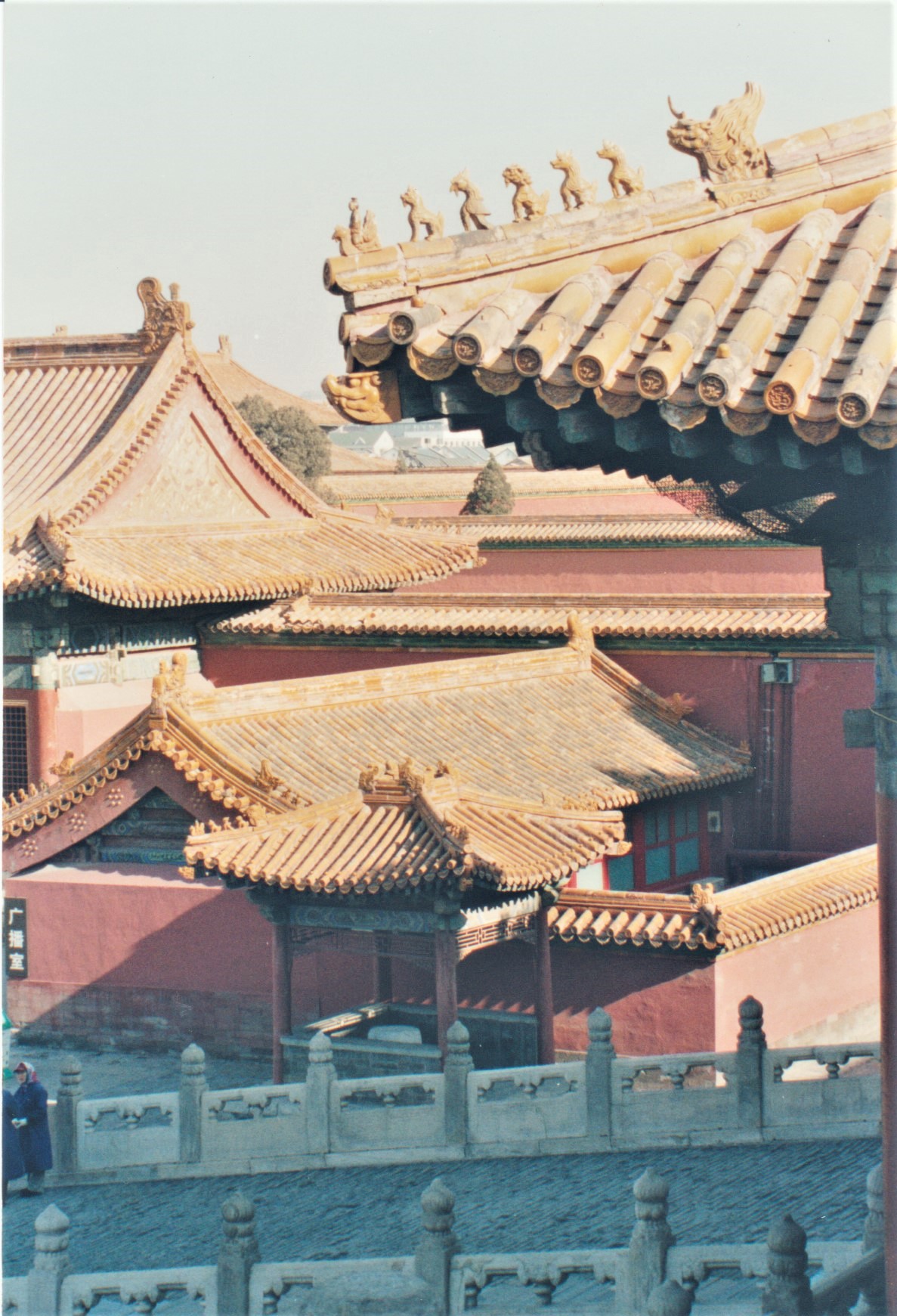
I did not strictly follow the recommended tour route of Meridian Gate, outer court, inner court, imperial garden, and exit from Gate of Divine Might. Though I spent close to 3 hours there, I largely stayed on the central axis with random detours to the left and right.
Not all the halls are accessible. Instead, visitors walked along its perimeter peering through the doorway and windows to view the interior.
3. Temple of Heaven (Tiantan)
From Forbidden City, a short bus ride got me here in the late afternoon. Though the sun was out, I felt cold, which impacted my enjoyment of this magnificent sacrificial site.
The Temple of Heaven in Beijing’s southeastern area is the largest compound of its kind in the world and is almost four times the size of Forbidden City. There are 92 ancient buildings spread out over 270 hectares (667 acres).
Originally built as the Altar of Heaven and Earth in 1420 AD by Yongle Emperor, the Temple of Heaven was enlarged by subsequent emperors of both Ming and Qing Dynasties, serving as the holy place to perform the heaven worship ceremony to thank the heavens and to pray for a year of rich harvest.

Image credit : Chinese History Digest
Temple of Heaven is divided by two encircling walls into an inner and outer altar. Aligned on the ends of the central axis of the inner altar are two primary buildings – the Altar of Prayer for Good Harvests (north) and Circular Mound Altar (south).
The inner wall in the north is semicircular while the southern part is square, representing the ancient Chinese cosmology of a Round Heaven and Square Earth.
Altar of Prayer for Good Harvest
The Altar of Prayer for Good Harvest was where the emperors prayed for favorable weather and ample harvest. The roof of the hall is covered with dark blue glazed tiles which represent the color of the sky.

The structure of the Hall of Prayer for Good Harvest is a wonder. Built entirely of wood, the triple-gable circular pavilion stands 38m high atop a three-tiered marble terrace base. Supported by 28 pillars, the inner 4 pillars are large, symbolizing the four seasons. The middle 12 pillars represent the twelve months. The outer 12 pillars indicate 12 periods of a day.

Gate to Imperial Hall of Heaven in the Temple of Heaven Compound.
The northern part and the southern part are connected by the 36m-long Danbi Bridge. Subsidiary buildings include the Imperial Vault of Heaven, the Hall of Abstinence, a Bell Tower and other smaller halls.
Circular Mound Altar
The Circular Mound Altar was where the sacrificial rite was held during winter solstice. Constructed much later in 1530, the Circular Mound is a round platform with three levels of bluestone. Each terrace is edged by white marble balusters. The number of flagstones in each circle and baluster posts are in multiples of nine, as nine represents infinity which is a characteristic of heaven.

Acoustics Test
Visitors cannot resist standing on the flagstone (Heart of Heaven) in the center, speaking in a low voice and waiting to hear an echo, in 0.07 seconds.

To the north of the Circular Mound is the Imperial Vault of Heaven, a smaller hall with only one circular gable and one level of marble stone base.
The memorial tablets of deities that were worshipped in the ceremony are kept here.
View of the Imperial Vault of Heaven, beyond the LingXing Gates from the Circular Mound Altar
As the day got colder and me more miserable, I decided to call it a day. Though there was more to visit, I skipped the rest of the sights including the spectacular gardens, pine woods and 60,000 variety of trees.
In 1998, the UNESCO listed the Temple of Heaven as a World Cultural Heritage, in recognition of its perfect combination of exceptional architectures and landscape, ancient sacred rites and modern leisure activities.
4. Summer Palace
The next day, I had forgotten my scarf when heading out but was too lazy to back track to get it. Luckily, it was a beautiful day minus the wind chill. I recall taking the subway to the end of the line, followed by a taxi for the final part.
Located on the western outskirts of Beijing, the Summer Place used to be the summer retreat for emperors and royal family members of the Qing Dynasty. Now a public park, the palace features hundreds of architecturally distinct buildings, halls, pavilions, pagodas, bridges and corridors dispersed among magnificent and elegant gardens. It has an area of 290 hectares (717 acres), three quarters of which is water.
The palace has three unique areas: Court Area, Longevity Hill Area and Kunming Lake Area.
Longevity Hill
After buying a through ticket at the East Gate, in an attempt to dodge a persistent tour guide, I darted up a path on the right, inadvertently taking the contra-route up Longevity Hill.
This 58m high Longevity Hill is the seat of some most important buildings of Summer Palace. The front hill is rich in splendid halls and pavilions; while the back hill, in sharp contrast, is quiet with natural beauty.


“Hall of the Sea of Wisdom’
This eye-catching structure glazed with over 1000 green and orange tiles sits at the top of hill. First built in 1750, the “Hall of the Sea of Wisdom’ is made of bricks and stones without a single beam to support the weight of the hall.


Inlaid on the wall around the arch gates are 1,008 glazed Buddha statues, arranged in neat rows. A statue of Kwan Yin is housed inside the Buddhist Hall.
Tower of Buddhist Incense
A symbol of the Summer Palace, the Tower of Buddhist Incense (Foxiang Pavilion) is the center of Summer Palace, with buildings distributed symmetrically around its base.
Perched on the hillside, the three-storied tower is a complicated structure with a height of 41m (131ft).

An elaborate work of classical architecture, it has eight facades with quadruple-layered eaves, supported by eight huge wooden pillars.
Long Corridor
Continuing downhill, my wanderings eventually led me to the Long Corridor at the southern foot of Longevity Hill facing Kunming Lake. The Long Corridor connects the three scenic areas in the Summer Palace, making it the ideal route for visiting the garden, rain or shine. It is the longest of its kind in the world at 728m long.
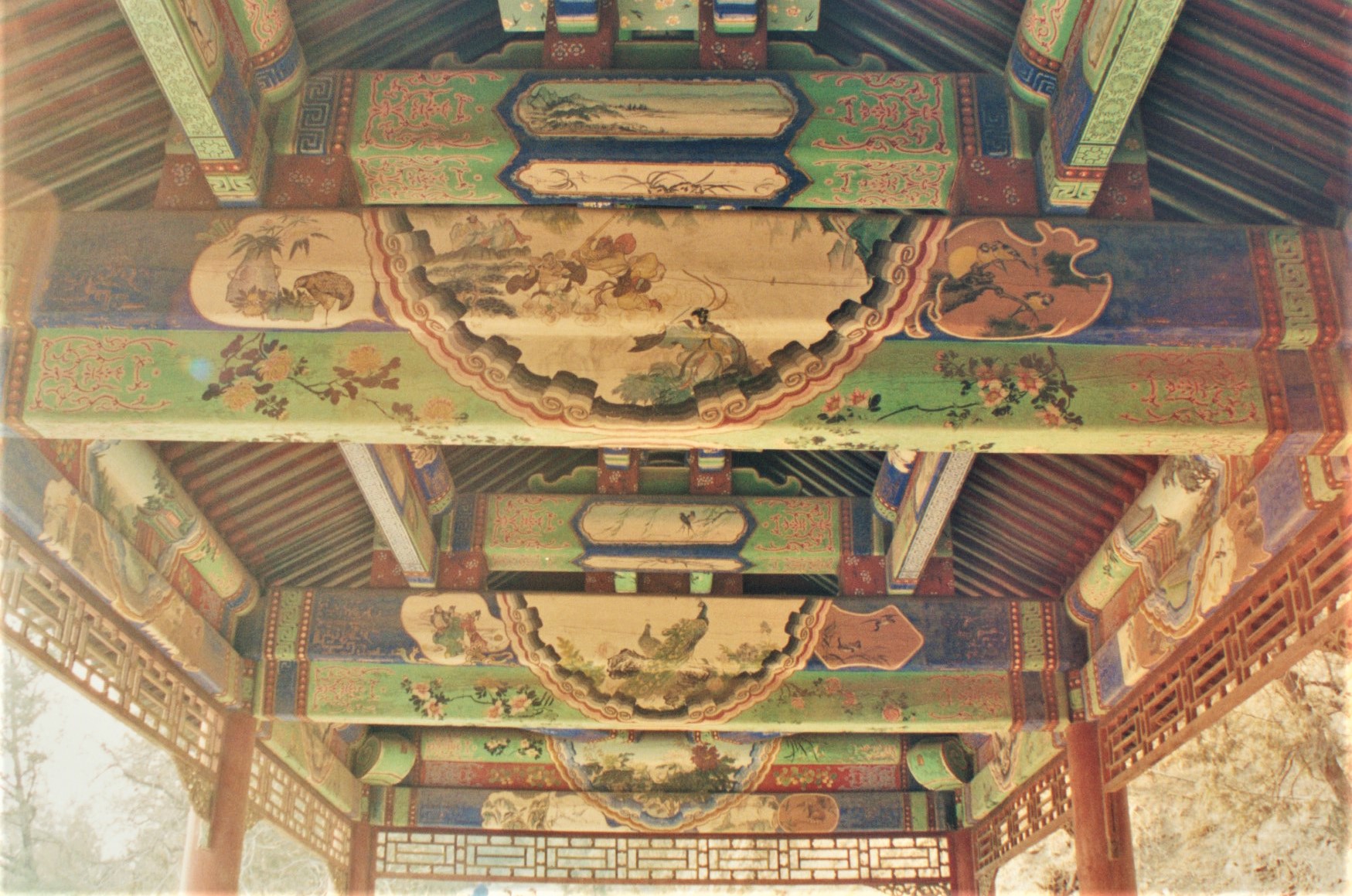
This exceptional art gallery has over 14,000 pictures of landscapes, flowers, birds, human figures and stories, painted magnificently on its beams and ceilings.
Feeling hungry, I munched on an apple as I walked its length along the bank of Kunming lake to the west. I foolishly removed my glove so that I could hold the apple. Bad idea as my hand was frozen numb by the time I finished eating.
Marble Boat
In the late afternoon, the rays of a watery sun on the lake seemed to be a fitting finale for a day of amazing sights and beautiful landscape.
I did not expect the breathtaking sight that awaited me at the western end of the lake. Afloat in the still waters was a two-storey Marble Boat, inlaid with colorful glass windows and wheels, and paved with coloured bricks. I tried to get as close as possible, peering inside from various angles to see the luxurious interior.


The Marble Boat is the only Western-style structure in the park. Originally built in 1755 in Chinese style, Empress Dowager Cixi had it rebuilt following western-style yachts in 1893, after its superstructure was destroyed (burnt) by the Anglo-French Allied Forces.
As it was getting late, I turned back, heading east towards the Court Area, foregoing the 17-Arch Bridge which is a fair distance away. As the only connection to Nanhu Island, one of three islands on Kunming Lake, the 17-Arch Bridge is the largest (8m wide) and longest (150m) bridge in the Summer Palace, with 17 symmetrical arches in diminishing sizes from the largest in the center.
The Court area consists of Leshou Palace, Yulan Palace and Yiyun Palace – the living zone of Cixi, Guangxu and his princesses. Making my way back to the East Gate entrance, my last stop was Renshou Palace, which served as the administrative center during the reign of Qianlong Emperor and Guangxu Emperor.
I spent almost an entire day exploring the most famous imperial garden in China, marveling at the classical features of distinctive buildings, feasting on islands and bridges on a natural lake, and totally loved it!
On 2 December 1998, Summer Palace was listed as a UNESCO World Heritage Site and declared a “masterpiece of Chinese landscape garden design”. The natural landscape of hills and open water is combined with artificial features such as pavilions, halls, palaces, temples and bridges to form a “harmonious ensemble of outstanding aesthetic value”.
5. Great Wall of China
The Great Wall has a history of over 2,000 years, though most of the Great Wall sections built before the Ming Dynasty (1368–1644) have disappeared due to adverse natural conditions and human activities. Only the sections built during the Ming Dynasty are still in good condition.
Made from brick, stone, tamped earth and wood more than 500 years ago, about 6,000km (70%) of the Ming-era Great Wall remains today, snaking its way over the parched mountainsides of the Gobi desert in northwestern China to the sea coast of far eastern China.

“Ming Wall” — the most continuous part of the Great Wall of China — is estimated to be around 8,851 km (5,500 miles) long.
Badaling Great Wall
I booked a day-tour to Badaling Great Wall to see China’s greatest engineering triumph.
Located approximately 80km northwest of Beijing’s city center, in Yanqing District, Badaling Great Wall is the best representative section of all Great Wall of China. The portion of the wall running through the site was built in 1504 during the Ming Dynasty, along with a military outpost reflecting the location’s strategic importance.
Upon arrival at the site, our guide shared that the North section is more difficult, while the South portion offers a more gentle climb.

Our group had a mother / daughter pair from Singapore, and the daughter and I naturally teamed up and chose to hike the northern section of the wall.
I vividly recall our guide’s parting words – Do not go beyond the fourth tower. Turn back as there will always be another tower waiting for you when you get there.

It was an exhilarating climb as we attacked the endless steep steps, embraced the constant elevation changes, and tolerated the uneven sloping ground.
The exertion sufficiently warmed me up and I no longer felt cold. I wanted to climb to the next tower as the wall winds continuously over the cliffy mountain range.
A damaged section of the wall
At the fifth tower, we reluctantly heeded our guide’s words and turned back. This time, taking a more leisurely pace, we focused on our surroundings and the stunning views. Up close, I was amazed by the solidness of the wall built with huge stone slabs. The mammoth effort to construct this massive structure in ancient times is simply mindboggling.
Walls
The walls at Badaling are higher (6 – 9m) and wider (6.5 – 7.5m) allowing 10 soldiers to walk abreast.

Fortress
The Great Wall is divided into many sections by the fortress. The mid-sized 20m ( w) x 8m (h) fortress at Badaling Great Wall is shaped like a trapezoid. Standing tall and strong, the fortress allows soldiers to spot enemies approaching from a distance and raise the alarm.
Towers
The Badaling Great Wall is connected by 43 towers of various sizes and functions, ranging from defense towers, watch towers, beacon towers, etc. Only four towers on the southern section and 8 towers on the northern section of Badaling Great Wall are opened to tourists.


Badaling Great Wall Facts
- Most of the preserved parts were built and reinforced during the Ming Dynasty (1368 – 1644 AD) to defend Beijing against the intrusion of northern Mongolians.
- The total length of this section is 12km (7.5 miles) with 43 watchtowers, however only 3.74km (2.3 miles) and 19 watchtowers have been restored and opened to visitors.
- In this section the wall averages about 7.8m (26ft) tall, and 6m (20ft) wide, which would allow five horses to gallop or ten soldiers to march abreast.
- It is built of huge bar-stones and bricks. The interior of the wall was stuffed with rammed earth and small stones to make it firm and solid.
- A number of holes have been drilled in the wall to shoot arrows and to watch enemies.
- The watchtowers were built to accommodate soldiers, send messages, observe the enemy, and store supplies. It also has shooting and observing holes.
 phoenixtrails.home.blog