Porth, a large coastal village on the outskirts of Newquay is our default base when holidaying in Cornwall. Even after 6 years, our preferred holiday accommodation at Porth Veor Manor Hotel was more than satisfactory with the 2-room apartment still well maintained. The fully equipped kitchen is even more complete than my own kitchen, so preparing Christmas dinner was not a problem.
Porth Beach – 25 December 2021
On Christmas day, after a lazy morning and leisurely lunch, we finally headed out for a walk, hoping to lessen the guilt of another face-stuffing at dinner.
The popular Porth Beach is just a stone’s throw away from where we stayed. In the ten minutes it took to get there, I hadn’t quite warmed up sufficiently nor adjusted to the cold outdoor temperature.
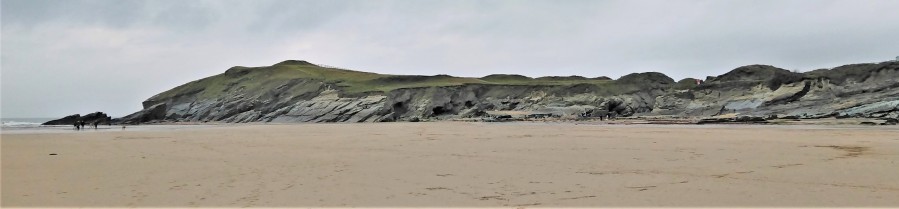
As I stepped onto the beach, I was struck by the large expanse of flat golden sand stretching out a long way to the sea.

Located on the eastern side of Newquay, Porth Beach is a narrow and shallow beach with a long tidal drop and soft golden sand.
At low tides it is possible to walk southwards to Newquay's Lusty Glaze Beach or northwards through the cleft at Porth Island onto Whipsiderry Beach and towards Watergate Bay (Tregurrian Bay).

Sheltered Beach
Going up the footpath, we saw how the headlands on both sides protect the beach, adding to its appeal for safe swimming.
Taking the footpath to Newquay, we followed the coastline south. When the path got too muddy, we turned inland, passing a residential area, before the views opened up again as the road skirted the cliff edge once more.
I would have taken the steps down to Lusty Glaze Beach if not for a “Private Access Only” notice on the gate. Disappointed, I consoled myself with shots of the cove from different angles, as the road curved around it.


For the next 10 minutes, we had unobstructed views of the shoreline around Newquay bay. Looking back towards Porth Beach, we could see a mist of spray against the distant cliffs, presumably where the waves were bigger and stronger.

We walked a bit further but could not find any access to the beach. We turned back towards Porth Beach, as Claire recalled seeing a way down along the footpath.
We found the stone staircase easily and joined the random groups of families with children and dog walkers heading to the sea.


Porth Island sits on top of Porth Beach, on the other side. To get there, we would have to cross rock pools and Porth Stream.
As Claire and Henry debated over getting their shoes wet (I had me ‘wellies’ on) we saw a family with kids crossing the narrowest part of the stream before climbing up the rocks and jumping down onto dry sand.


Claire and Henry wisely chose the longer but dry route, while I plunged in.
The water reached above my ankles and I could feel a slight tug of current as I slowly waded across four feet of flowing water. At the rocks, I clambered up the uneven slope, walked along the top past the stream, and hopped down beyond the water line.
From this side of the beach looking back towards Porth town, I was surprised by how far out we had walked, without realising it.


I wandered around the many rock pools for a bit before looking for a way up to Porth Island.

From the bottom, the sloping smooth rockface to the top looked daunting. Luckily, I had seen others going up without too much trouble, so was confident I could make it.
I did, emerging just before the footbridge access to Porth Island.

View of the steep rock gully from the footbridge, with Porth Beach and Newquay in the background.
This bridge crossing gets more exciting on a rising tide. On windy days, a blow hole can be seen at mid tide!

While waiting for Claire and Henry, I turned north onto the South West Coast path, capturing dramatic views of the rugged coast, with Porth Island as the backdrop.
Below are two shots of Porth Island with identical picture composition taken in 2021 (top) and 2015 (bottom) respectively. I must have unknowingly been standing almost at the exact same spot from six years ago.


Following the path as it curved right, I recognised the cove (Whipsiderry Beach) we had so much fun exploring on my first visit. I would have loved to visit again, in a heartbeat.

Having dithered away 15 minutes, I hurried back to the footbridge. Claire and Henry were already there, waiting to start our walk around Porth Island. At the halfway mark at a trail split, we kept right, heading up the slight incline to the tip of the promontory.


Porth Island offers a pleasant walking experience with its natural features, fabulous views and the remains of an Iron Age promontory fort as well as two Bronze Age round barrows.
All these can be seen on a circular walk that follows the perimeter of the island, before retuning to the footbridge.

Out in the open with no protection against the wind and cold, we were disinclined to linger overly long. It was past 4pm and time to head back. This time, we all took the longer route back to our starting point on Porth Beach Road.

Whipsiderry Beach – 23 December 2015
On the morning before heading home, we parked along the road and discovered this secluded, quiet beach just around the corner from Porth Beach.
Located below some of the steepest, sheer cliffs in the area, Whipsiderry Beach is a little-known cove just to the north of Newquay, between Watergate Bay and Porth Beach.


From the road, about 100 steep and uneven steps carved out of the cliff is the only access to the beach.
Nb. There is no beach at high tide


Surrounded by incredible high cliffs, Whipsiderry is accessible only during low tide via a steep stairway. As there are no facilities here, it is less crowded and one of Newquay’s quieter beaches even in the peak summer season.
But, once past the steep steps, there is lots to explore – caves, rock pools and dry sand for sheltered sun bathing.

The best time to visit is at low tide, when the sand is firm to walk. This hidden beauty has a gently sloping sandy bottom that ensures waves break evenly along its length, both left and right.

It was a beautiful sunny morning with no wind. The beach walk was absolutely delightful.


We had fun testing the sand and clambering over rocks to avoid puddles in an attempt to reach the waves.
At high tide, the 600m beach is cut off by the sea. This is evidenced by entire colonies of mussels encrusted on the rock formations and rock islands littering the beach.


This sandy sheltered cove has a couple of small and intriguing caves. The large rock island in the middle of Whipsiderry Beach is called Black Humphrey Rock, named after a notorious Newquay smuggler, who used it as his hiding place. Black Humphrey lived to a good age and died in the early 1800s.

Ravaged by the sea over the years, Black Humphrey Rock is much reduced in size now. Going closer, we discovered an opening big enough to fit all four of us, with an exit on the other side.


After a blissful hour, it was time to start the five-hour drive back to Surrey and hopefully avoid the Christmas rush.
 phoenixtrails.home.blog